Sep 8, 2026News & Insights
Fernando Botero: Life, Style, Sculptures, and the Art of Exaggerated Volume
While Botero achieved worldwide acclaim for his paintings, his mid-career expansion into monumental outdoor bronzes solidified his legacy as a titan of contemporary public sculpture.
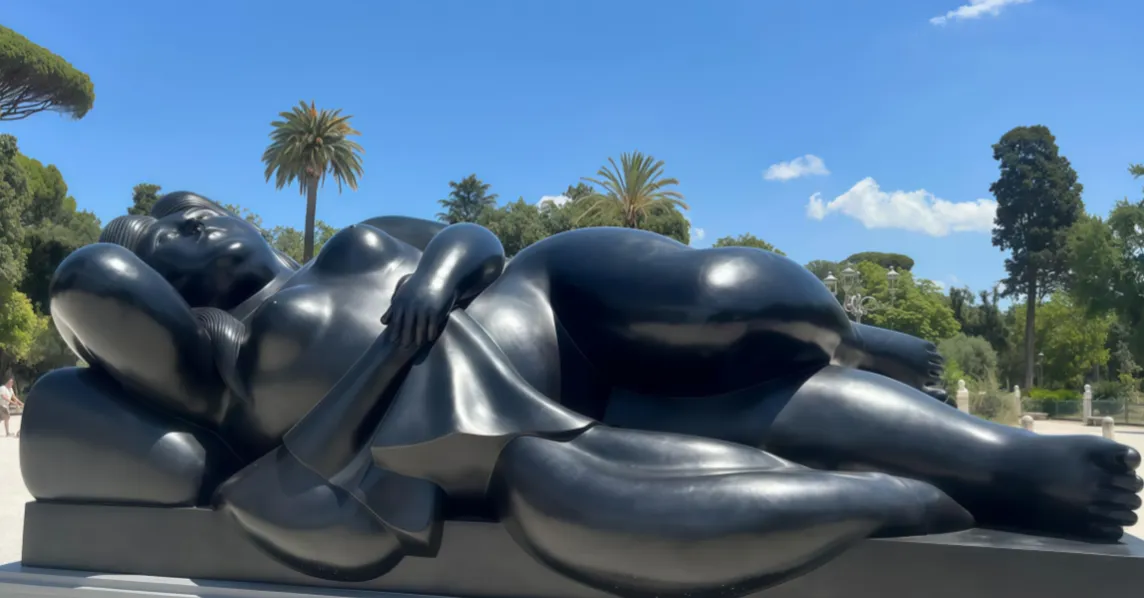
Fernando Botero (1932–2023) was one of the most recognizable Latin American artists of the 20th and 21st centuries. Born in Medellín, Colombia, Botero developed an unmistakable visual language based on exaggerated volume, rounded forms, monumental proportions, irony, sensuality, and humor. Although he was internationally celebrated as a painter and draftsman, his bronze sculptures became an equally important part of his legacy.
Botero began making sculpture in the early 1970s, translating the inflated forms of his paintings and drawings into three dimensions. His monumental bronzes—depicting women, men, horses, cats, birds, dancers, mythological figures, and everyday objects—eventually appeared in major public spaces around the world. The Public Art Fund's 1993 Botero in New York exhibition, for example, presented 14 monumental bronzes along Park Avenue and two additional sculptures at Doris C. Freedman Plaza.
Artistic Evolution and the Genesis of Boterismo:
对比图
The Sculptural Medium: Materials, Aesthetics, and Pietrasanta:
In 1973, Botero relocated his primary residence to Paris, where he expanded his volumetric investigations from canvas into three-dimensional sculpture. While he had created isolated relief sculptures in the late 1960s, his formal transition to sculpture reflected a logical progression: the inflated volumes he had spent two decades painting demanded physical, tactile reality. He debuted his initial sculptural output at the Grand Palais in Paris in 1977.
To achieve technical mastery over bronze and marble, Botero established a residence and studio in Pietrasanta, Tuscany, in the early 1980s. Located near the Carrara marble quarries, Pietrasanta offered access to centuries-old foundries (such as Fonderia Artistica Mariani and Fonderia Massimo Del Chiaro) and master artisans. In Pietrasanta, Botero mastered the lost-wax (cire perdue) casting technique for bronze, alongside direct carving in local marble.
The aesthetic philosophy guiding Botero's sculptural work centers on several core principles:
Volumetric Inflation as Aesthetic Expression: Contrary to popular misconceptions that Botero painted or sculpted "fat people," the artist consistently clarified that his subject matter was volume itself. Exaggerated mass served to glorify form, heighten sensuality, and assert spatial dominance.
Tactile Surface Continuity: Botero’s sculptures feature smooth, continuous convex curves that erase tool marks. His hand-rubbed patinas—ranging from deep obsidian black and dark chocolate brown to warm golden verdigris—interact dynamically with natural light, inviting physical touch from viewers.
Spatial Equilibrium and Balance: Despite their immense physical weight, Botero's figures exhibit a delicate balance. By anchoring massive torsos atop tapering limbs or delicate hooves, he generated a subtle tension between mass and buoyancy.
Subversion of Classical Monumental Typologies: Botero systematically reinterpreted classical statuary—equestrian monuments, reclining Venuses, mythological beasts, and military heroes—stripping them of authoritarian stiffness and imbuing them with gentle, accessible forms.
By scaling his figures to monumental proportions, Botero fundamentally reconfigured public art. Rather than elevating figures on high pedestals that separated them from urban life, he frequently sited his bronzes directly at ground level in public squares, encouraging everyday human interaction.
Major Sculptural Masterworks and Visual Catalog:
Botero's output in sculpture comprises hundreds of monumental bronzes installed across major cities worldwide. The following major works illustrate his thematic range, technical mastery, and spatial legacy.
- Man on Horse (Hombre a Caballo, 1992)
Man on Horse (1992), patinated bronze sculpture by Fernando Botero, permanently sited at the Israel Museum, Jerusalem. Photo credit: Wikimedia Commons (Public Domain)
In Man on Horse, Botero revisits the classical European equestrian monument—historically used to celebrate military conquest and imperial power—and reinterprets it through his volumetric framework. The rider sits atop an immensely swollen, muscular steed whose delicate legs and small hooves create a striking visual contrast. Rather than portraying an aggressive commander, the rider appears placid and disarmed. Botero subverts traditional political monumentality, transforming a symbol of dominance into a harmonious exploration of mass and form. Castings of this sculpture reside in major collections worldwide, including the Israel Museum in Jerusalem and Botero Plaza in Medellín.
- Bird (El Pájaro, 1990)
Bird (1990), monumental bronze by Fernando Botero, installed along the Singapore River in front of UOB Plaza, Singapore. Photo credit: Jorge Láscar
Botero's avian sculptures demonstrate his ability to convey weight and lightness simultaneously. Bird (1990) features a spherical body, small wings, and a short beak resting on sturdy legs. Installed along the Singapore River at Boat Quay, the sculpture serves as a visual anchor in the city's financial center. The inscription on the Singapore monument notes that the bird symbolizes peace, serenity, and optimism. The polished patina highlights the soft, flowing contours of the creature, drawing passersby to engage with its presence.
- Broadgate Venus (1989)
The Broadgate Venus (1989), patinated monumental bronze in Exchange Square, London. Photo credit: Bobulous
Sited in Exchange Square behind Liverpool Street Station in London, The Broadgate Venus is one of Botero's largest outdoor bronze sculptures. Measuring over five meters in length, the sculpture depicts a massive nude woman reclining on her stomach, resting her chin on her hands while looking upward. Botero reinterprets classical representations of Venus (such as those by Giorgione, Titian, and Velázquez), replacing idealized proportions with expansive volume. Positioned in a commercial plaza, the bronze offers a warm, organic contrast to the glass and steel architecture of the surrounding district.
- Woman with Mirror (Mujer con Espejo, 1987)
Mujer con Espejo (1987), bronze sculpture located at Plaza de Colón, Madrid, Spain. Photo credit: Midir (Public Domain)
Gifted to the city of Madrid following Botero's major retrospective exhibition in 1994, Mujer con Espejo depicts a voluptuous woman lying comfortably on her stomach, holding a small handheld mirror. The play between the figure's massive form and the delicate mirror illustrates Botero's manipulation of scale. Located on Plaza de Colón along Paseo de la Castellana, the sculpture has become an iconic landmark in Madrid's urban landscape.
- The Hand (La Mano, 1992)
La Mano (1992), bronze sculpture by Fernando Botero, installed on Paseo de la Castellana, Madrid. Photo credit: Wikimedia Commons
La Mano demonstrates Botero's engagement with anatomical fragmentation. Rising directly from the ground on Paseo de la Castellana in Madrid, the monumental bronze hand features short, thick fingers and an upturned palm. Botero strips the hand of dramatic gesture, presenting it as an open, monumental form defined by volume. The dark, polished surface reflects ambient light across its curves, transforming a human body part into a monumental landscape.
- The Bird of Peace (El Pájaro de la Paz, 1995 / 2000)
The destroyed original "Pájaro" (1995) alongside the replacement "Pájaro de la Paz" (2000) in San Antonio Park, Medellín. Photo credit: Wikimedia Commons (Public Domain)
One of Botero's most politically charged public works, El Pájaro carries a historic civic legacy. On June 10, 1995, during a street concert in San Antonio Park, Medellín, a terrorist bomb detonated at the base of Botero's 1995 bronze bird sculpture, killing 23 people and injuring more than a hundred. Botero insisted that the city leave the shredded bronze structure in place as a permanent memorial to the victims and a condemnation of violence. Five years later, in 2000, Botero created a new, intact bronze bird—El Pájaro de la Paz—and placed it beside the destroyed original. The side-by-side installation stands as a powerful symbol of resilience, memory, and peace.
Catalog of Representative Masterworks:
The following structured table summarizes key works across Botero's career, highlighting their media, locations, and aesthetic significance.
对比图
Art Market Performance, Global Recognition, and Institutional Impact:
Botero achieved exceptional commercial success and global critical acclaim during his lifetime. His career included more than 70 solo museum exhibitions in major art capitals across North America, Latin America, Europe, and Asia. In 1992, he became the first living foreign artist ever invited to exhibit monumental sculptures along the Champs-Élysées in Paris. Later, in 2015–2016, his anthological exhibition toured the National Museum of China in Beijing and the China Art Museum in Shanghai, marking his standing as a global living master.
In the international art market, Botero's monumental sculptures consistently set auction records for Latin American art. In March 2022 at Christie's New York, his bronze sculpture Man on Horseback (Hombre a Caballo) sold for 4.3 million USD, setting an auction record for his work. His sculptures and paintings remain key holdings in major international institutions, including the Museum of Modern Art in New York, the Art Institute of Chicago, the Israel Museum in Jerusalem, and the Museo Botero in Bogotá.
Conclusion:
Fernando Botero passed away on September 15, 2023, in Monaco at the age of 91, due to complications from pneumonia. His legacy lives on through the visual language of "Boterismo"—an aesthetic framework that expanded the treatment of volume and mass in modern art.
By combining Renaissance principles of perspective and form with Latin American folklore and contemporary themes, Botero built a universal art style that bridged regional and global traditions. His decision to place monumental bronze sculptures directly in public spaces transformed the relationship between outdoor art and urban audiences, making art accessible to millions. Botero's masterworks remain a testament to the power of volume, tactile form, and humanistic figurative art.