Sep 7, 2026News & Insights
Who Was Alberto Giacometti?
The Giacometti Foundation describes Walking Man as an icon of 20th-century art, while major museums such as MoMA and The Metropolitan Museum of Art preserve important examples of his work.
Who Was Alberto Giacometti?
Alberto Giacometti (1901–1966) stands as one of the most transformative sculptors of the 20th century. Renowned for his attenuated, elongated human forms, his work captured the psychological vulnerability, existential isolation, and spatial anxiety of the post-World War II era. Moving beyond pure representation, Giacometti revolutionized visual art by sculpting not the body itself, but the perceptual experience of seeing a human figure across distance and void.
Life and Artistic Evolution:
Born in Borgonovo, Switzerland, to Impressionist painter Giovanni Giacometti, Alberto was steeped in artistic practice from an early age. His stylistic evolution spans several distinct phases:
Post-Cubist & Surrealist Period (1925–1935): After moving to Paris to study under Antoine Bourdelle (a pupil of Auguste Rodin), Giacometti aligned with André Breton's Surrealist movement. During this time, he created dreamlike, architectural, and emotionally charged objects.
The Scale Crisis & Miniature Phase (1938–1944): Striving to capture human presence accurately, Giacometti found his sculptures shrinking as he worked. To mirror the exact distance from which he viewed his models, figures became tiny—often no larger than a cigarette lighter.
The Mature Existential Period (1945–1966): Emerging from WWII, Giacometti developed his signature style: tall, thin, heavily textured bronze figures. These threadlike silhouettes came to embody the philosophy of Existentialism championed by his close friend Jean-Paul Sartre.
Core Aesthetic & Philosophical Themes:
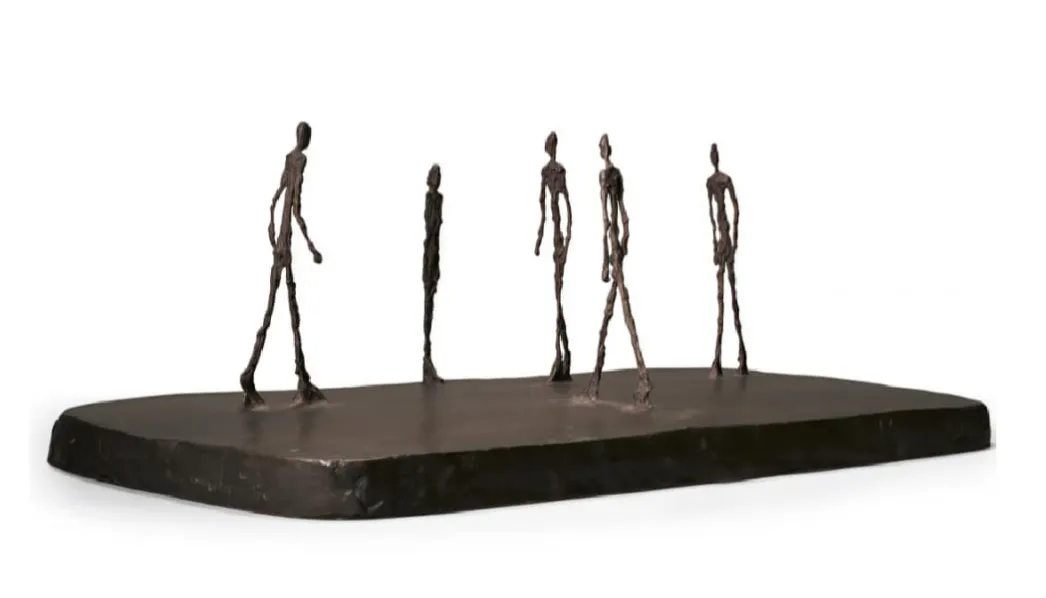
Perceptual Distance and Space: Giacometti did not create anatomical likenesses; he sculpted the optical sensation of a figure standing at a specific distance. The negative space around his 8 Most Famous bronze Sculptures forms is not an empty void—it actively encroaches upon and defines the body.
Existential Isolation and Human Fragility: Giacometti's post-war figures—with their heavily scraped, eroded surfaces—reflect the alienation, resilience, and mortality of post-war Europe. Though standing on heavy, immovable bases, his figures appear weightless yet anchored, perpetually striving to connect.
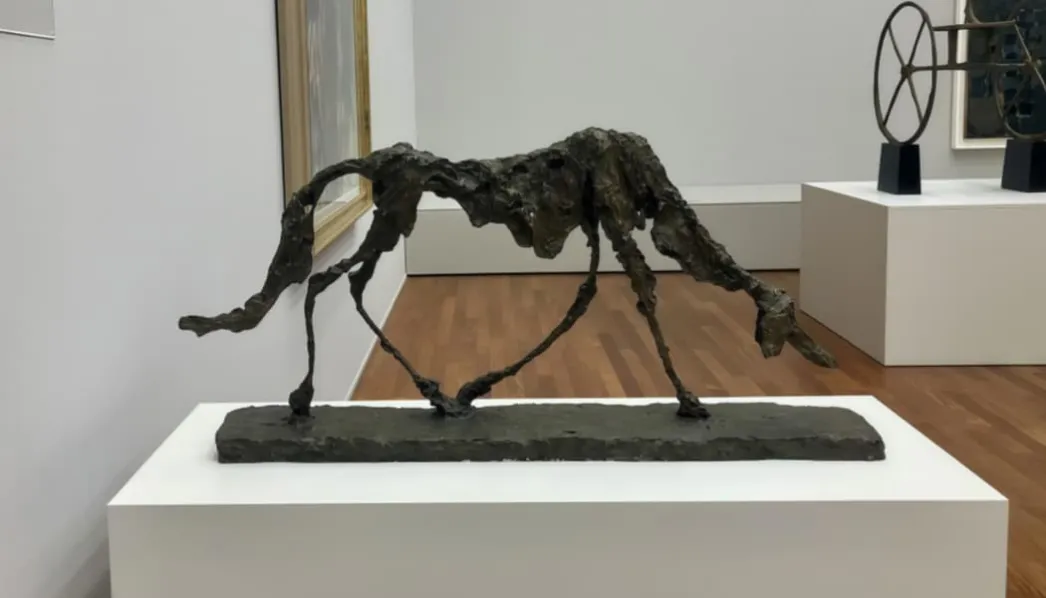
Tactile Expressiveness: His sculptures feature intensely worked surfaces. Modeling in plaster and clay before casting in bronze, Giacometti left deep thumb impressions and knife marks, giving every inch of metal a visceral, living energy.
Major Sculptural Masterpieces:
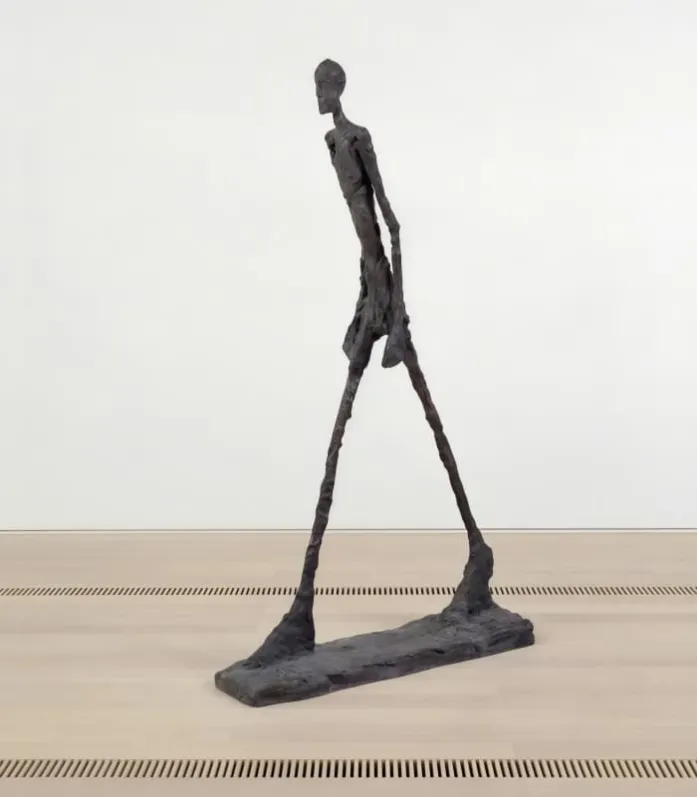
- L'Homme qui marche I (Walking Man I),1960
Perhaps the most iconic sculpture of modern art, L'Homme qui marche I depicts a tall, thin man captured mid-stride. Despite the figure's eroded surface and fragile structure, his oversized feet are firmly rooted, symbolizing relentless human perseverance. In 2010, a bronze cast of this masterpiece set a historical benchmark at auction, emphasizing its standing in modern art history.
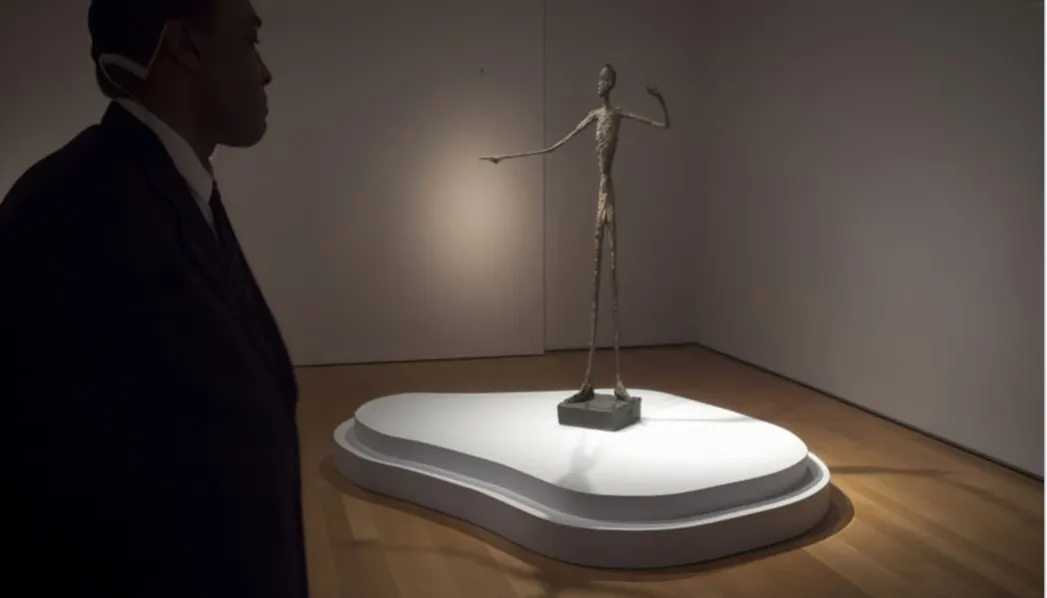
- L'Homme au doigt (Man Pointing),1947
Created in a single nocturnal session, L'Homme au doigt showcases a slender figure gesturing into open space. The life-sized statue serves as a study in phenomenology and existential vectoring—the figure points into the unknown void, leaving its gesture open to interpretation as either a warning, a direction, or a plea.
- Le Palais à 4h du matin (The Palace at 4 a.m.),1932
A masterwork from his Surrealist phase, this open-cage construction blends wood, glass, wire, and string. Functioning as a spatial dreamscape, the piece brings together disparate objects—a pterodactyl-like skeleton, a female silhouette, and a spinal column—evoking memory, nocturnal vulnerability, and subconscious desire.
Key Overview of Major Works:
| | | | |
| | | | |
| | | | |
| | | | |
| | | | |
| | | | |
| | | | |
| | | | |
More than half a century after his death, Giacometti's work remains remarkably contemporary.
His sculptures speak to issues that are still relevant:
Loneliness in modern cities
Individual identity
Human vulnerability
Psychological distance
The relationship between people and space
The difficulty of representing reality
His figures do not look like conventional portraits.
Instead, they look like signs of human existence.
That is precisely what gives them their extraordinary power.
Conclusion:
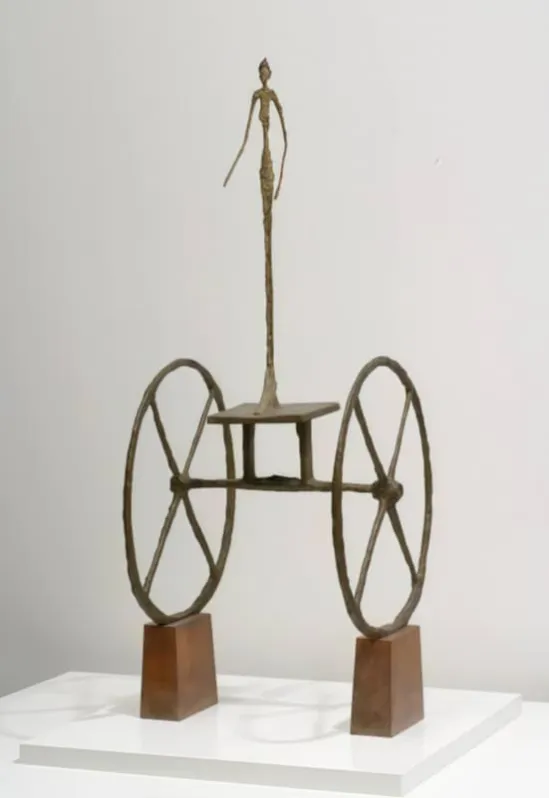
Alberto Giacometti transformed modern sculpture by reducing the human figure to its essential presence.
His elongated men, women, and animals may appear fragile, but they possess enormous emotional and visual power.
From the Surrealist architecture of The Palace at 4 a.m. to the iconic Walking Man, Giacometti's career demonstrates a lifelong search for a fundamental artistic question:
How can sculpture represent the human being as we actually experience them in space?
His answer was radically different from classical sculpture.
He abandoned idealized anatomy, smooth perfection, and conventional monumentality.
Instead, he created thin, rough, vulnerable figures surrounded by enormous amounts of empty space.
The result was a new visual language for the human condition.
For modern artists, collectors, museums, and bronze sculpture enthusiasts, Alberto Giacometti remains one of the defining masters of 20th-century sculpture.
His Walking Man has become an icon of modern art, while his distinctive elongated bronze figures continue to influence contemporary figurative and abstract sculpture around the world.