Sep 9, 2026News & Insights
Why Constantin Brâncuși Matters Today?
Among his best-known works are Bird in Space, The Endless Column, The Kiss, Sleeping Muse, Mademoiselle Pogany, The Newborn, Maiastra, and Fish.
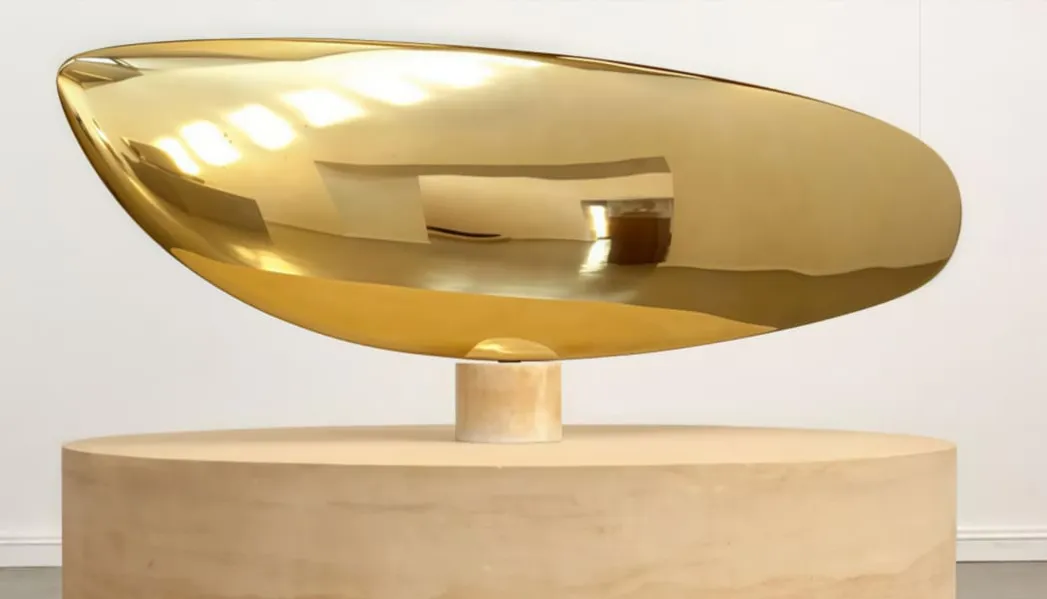
Constantin Brâncuși (1876–1957) was a Romanian-born sculptor whose radical approach to form, material, and space redefined 20th-century art, earning him the title of the "Father of Modern Sculpture." By stripping away extraneous detail to reveal the essential spirit of his subjects, Brâncuși bridged primitive folklore with sleek, modern minimalism.
Rather than attempting to reproduce the external appearance of people, animals, or objects, Brâncuși searched for what he considered their essential nature. His sculptures often appear remarkably simple: an elongated oval, a polished bronze form, a geometric column, or a simplified human head. Yet behind this simplicity lies a sophisticated investigation of movement, balance, material, light, space, and perception.
Brâncuși's radical approach changed the language of sculpture and influenced generations of modern and contemporary artists. Today, his work can be found in major museums and collections around the world, including The Museum of Modern Art in New York and the Centre Pompidou in Paris.
Historical Context and Early Trajectory:
Born on February 19, 1876, in the rural village of Hobița, situated in Gorj County near the Carpathian Mountains of Romania, Brâncuși grew up in an environment rich in folk artisan traditions and vernacular woodworking. His early life was defined by manual craftsmanship; at an early age, he learned to carve wooden farm tools and domestic items, developing an intuitive understanding of organic materials.
Brâncuși formally pursued art education at the School of Arts and Crafts in Craiova and subsequently at the National School of Fine Arts in Bucharest. Seeking exposure to the center of the avant-garde, he migrated to Paris in 1904, enrolling in the École des Beaux-Arts under Antonin Mercié.
Brâncuși's exceptional technical skill caught the attention of Auguste Rodin, the dominant sculptural master of the era. In 1907, Brâncuși was invited to join Rodin's studio as an assistant. However, he departed after merely two months, uttering his famous maxim: "Nothing can grow under big trees." This departure marked a decisive rupture in the history of sculpture. Where Rodin relied on clay modeling, literary allegory, and industrial bronze casting, Brâncuși turned toward direct carving, structural economy, and material truth.
Artistic Philosophy and Technical Innovations:
Direct Carving and Material Integrity: Brâncuși's rejection of foundry intermediaries led to his revival of direct carving (taille directe) in wood, marble, and limestone. He asserted that the sculptor must respect the innate physical properties of the raw material. The grain of the oak, the veining of the marble, and the reflectivity of polished bronze were not incidental qualities to be masked, but primary components of the artwork's meaning.
Reduction to Essence and Abstraction: Unlike the descriptive realism of academic sculpture, Brâncuși sought absolute purity of form. His process was not one of inventing abstract geometric shapes ex nihilo, but rather a progressive distillation of natural subjects. Human heads were simplified into polished ovoids, birds were stripped of wings and feathers to express pure upward propulsion, and human forms merged into singular monolithic blocks.
The Dissolution of the Pedestal: Historically, pedestals served as passive structural supports separating sacred art from mundane space. Brâncuși revolutionized this convention by integrating bases directly into the sculptural composition. Carved from contrasting materials—such as rough-hewn wood beneath pristine marble—these bases functioned as modular, rhythmic components that grounded the ethereal, polished surfaces above.
Photography as Studio Practice and Medium: Brâncuși was an early innovator in using photography not merely for archival documentation, but as an extension of his sculptural thought. Mentored by Man Ray and collaborating with figures like Edward Steichen, Brâncuși controlled every photographic variable in his Paris studio. He photographed his sculptures under specific light conditions to capture ambient reflections, halo effects, and dynamic spatial relationships, presenting his works as living, mutable entities within their environment.
Catalog of Major Masterpieces:
The following catalog outlines Brâncuși's most significant works, detailing their medium, key structural characteristics, primary themes, and current holdings.
对比图
Analysis of Key Masterworks:
- The Kiss (1907–1908)
Created as an explicit departure from Rodin's dramatic, fluid sculpture of the same title, Brâncuși's The Kiss represents the beginning of proto-cubist non-literal representation and direct carving. Carved directly into stone, the two lovers are bound together inside a symmetrical, upright block. Their arms form right angles wrapping around the perimeter, while their eyes merge into a single shared oval. By retaining the rectangular truth of the stone block, Brâncuși created an enduring symbol of eternal union, stripping the subject of erotic theatricality in favor of structural integrity and archaizing clarity.
- Sleeping Muse (1910)
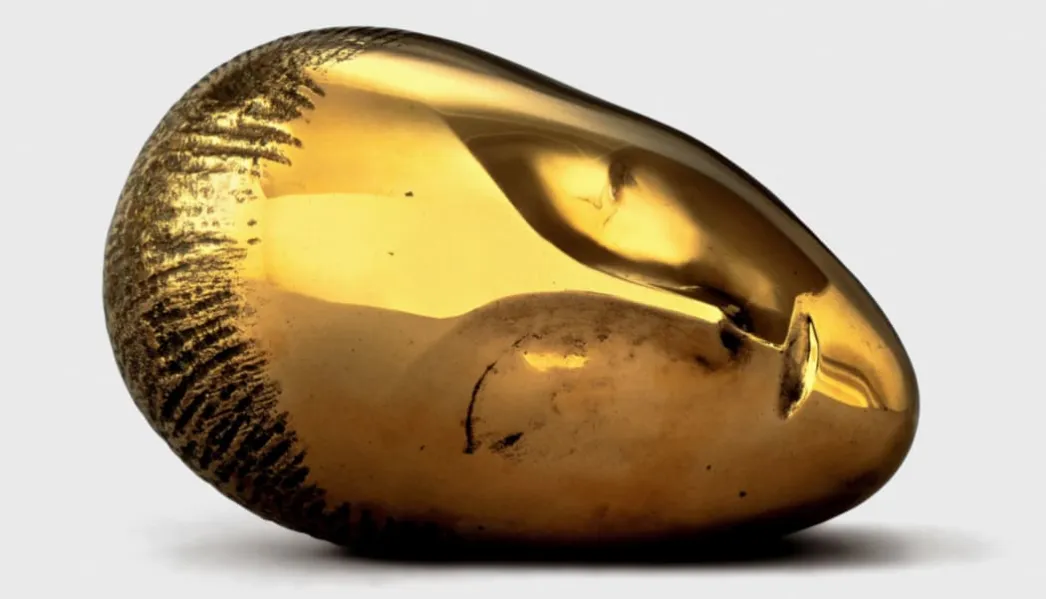
Modeled originally after Baroness Renée-Irana Frachon, Sleeping Muse marks Brâncuși's decisive transition toward the egg-like ovoid—a form he regarded as the archetype of organic life and rebirth. The head rests horizontally on its side, separated from any neck or torso. Facial details such as eyelids, nose, and mouth are reduced to delicate, low-relief incisions across the smooth bronze surface. The mirror-like finish of the cast bronze reflects light, causing the physical mass of the sculpture to dissolve into ambient luminescence.
- Bird in Space (1923–1940)
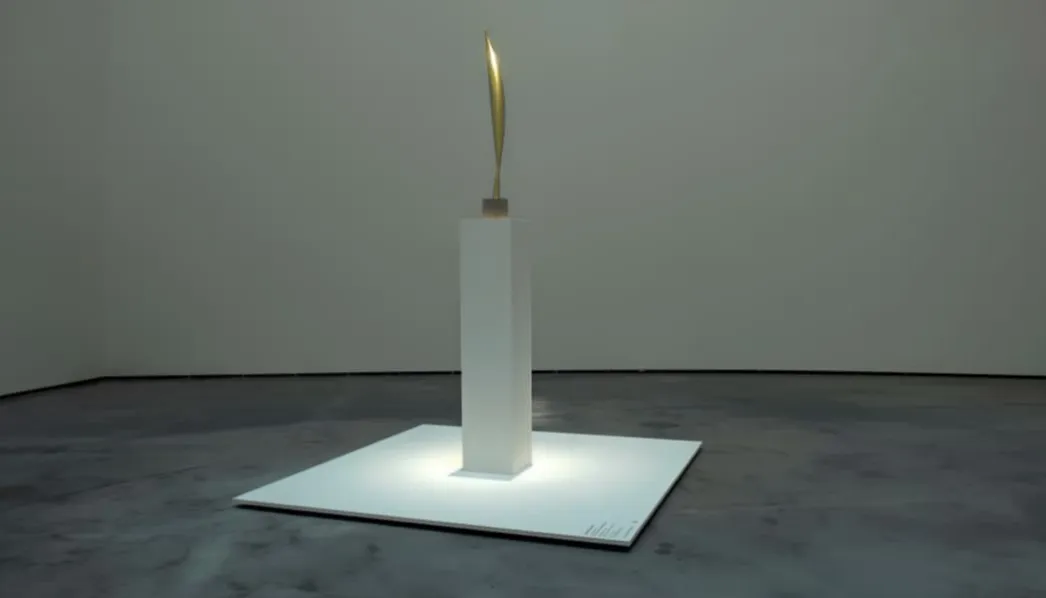
The Bird in Space sequence evolved over three decades from earlier mythological avian explorations, such as the Romanian folk-inspired Măiastra (1910–1918) and Golden Bird (1919). Across 16 identified versions in bronze and marble, Brâncuși completely eliminated anatomical features—wings, feet, and feathers were abandoned in favor of an ascending curved spire. The sculpture features a swollen midsection tapering down to a slender conical footing, terminating in an angled top plane that suggests an open beak accelerating upward into the sky. The high polish of the metallic versions absorbs and reflects the surrounding environment, creating a visual effect of weightlessness and pure motion.
- The Endless Column (1937–1938)
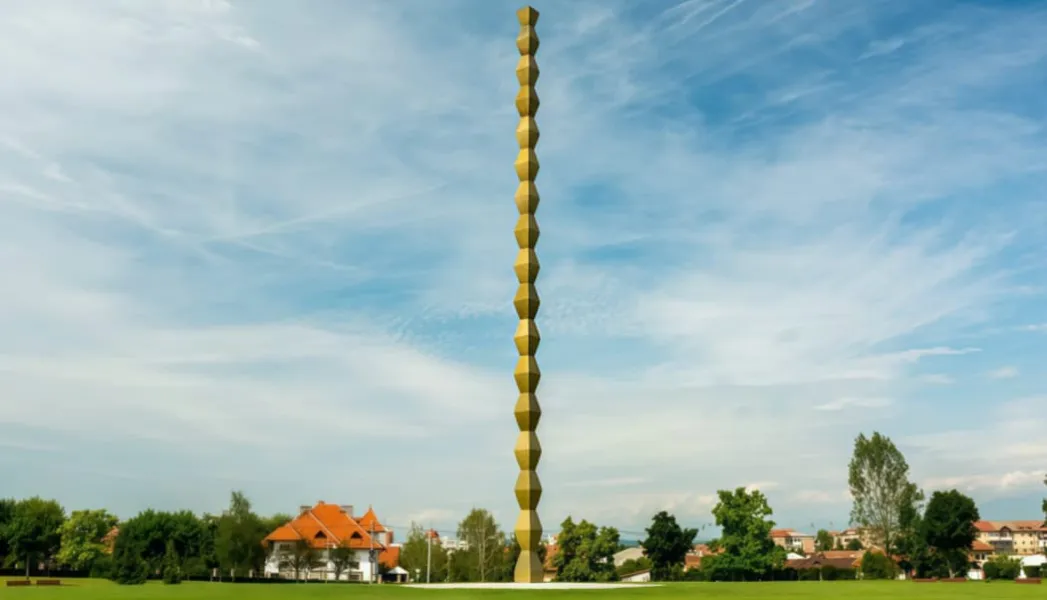
Standing at 29.3 meters (nearly 98 feet) in height, The Endless Column forms the centerpiece of the monumental ensemble in Târgu Jiu, Romania. Engineered with the assistance of engineer Ștefan Georgescu-Gorjan, the column consists of 15 fully formed rhomboidal modules, flanked by half-units at the top and bottom, stacked along a central interior steel spine. The repetition of identical geometric units creates an optical illusion of infinite vertical extension. Drawing directly upon the architectural motifs of traditional Romanian timber gate pillars, Brâncuși elevated folk vernacular design into a modern monument honoring fallen soldiers of World War I, symbolizing infinite sacrifice and connection between earth and sky.
Cultural Impact, Secondary Market, and Heritage Preservation:
Brâncuși's reduction of form profoundly influenced subsequent generations of twentieth-century movements, notably Minimalist sculpture, modern architecture, and Conceptual Art. His emphasis on modularity, industrial finishing, and environmental reflection directly anticipated late-modernist spatial practices.
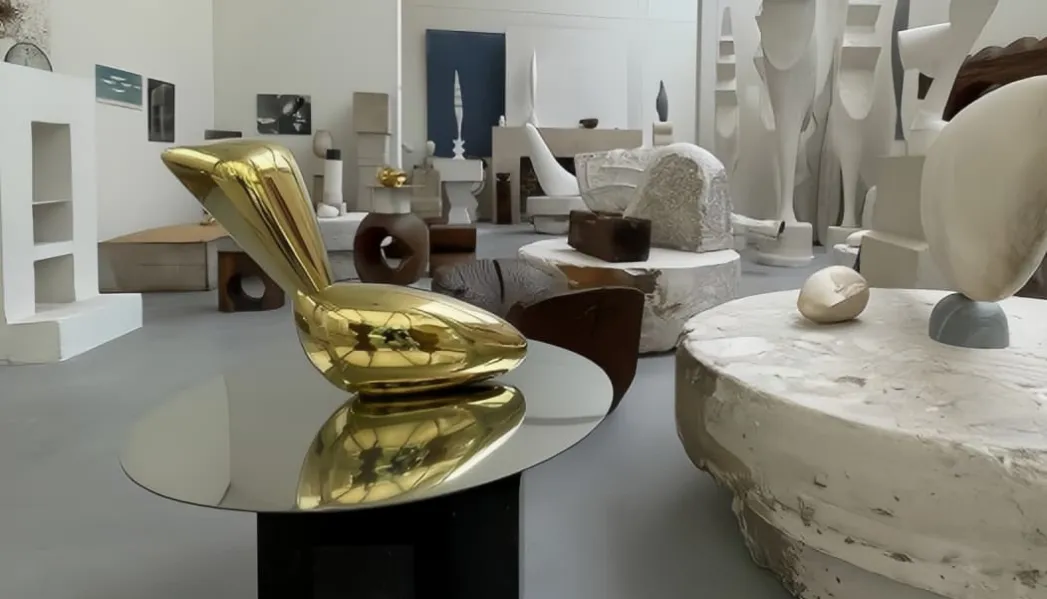
Upon his death on March 16, 1957, Brâncuși bequeathed his entire Paris studio at 11 Impasse Ronsin—including completed sculptures, bases, tools, furniture, and thousands of original photographic glass plates—to the French state. Faithfully reconstructed adjacent to the Centre Pompidou as Atelier Brâncuși, the space remains a critical museum dedicated to preserving the spatial context in which his works were conceived.
On the secondary art market, Brâncuși’s works rank among the most valued sculptures in history. In 2018, his polished bronze portrait La Jeune Fille Sophistiquée (Portrait de Nancy Cunard) (1932) achieved an auction price of $71 million at Christie's New York, establishing a world auction record for the artist and reinforcing his position within the global canon.
Conclusion:
Constantin Brâncuși redefined three-dimensional art by bridging archaic folklore with modernist abstraction. Through his mastery of direct carving, structural base integration, dynamic studio photography, and radical formal economy, he liberated sculpture from narrative representation. From the stone blocks of The Kiss to the soaring modules of The Endless Column, Brâncuși's oeuvre demonstrated that the ultimate objective of modern art is not to mirror the external reality of objects, but to capture their enduring spirit, essence, and transcendent form.